Expand Smarter in the Progressive Multifocal Leukoencephalopathy Treatment Market – With This 2025–2034 Forecast Report
Unlock 30% off global market reports with code ONLINE30 — get insights on tariff changes, macro trends, and global economic shifts.
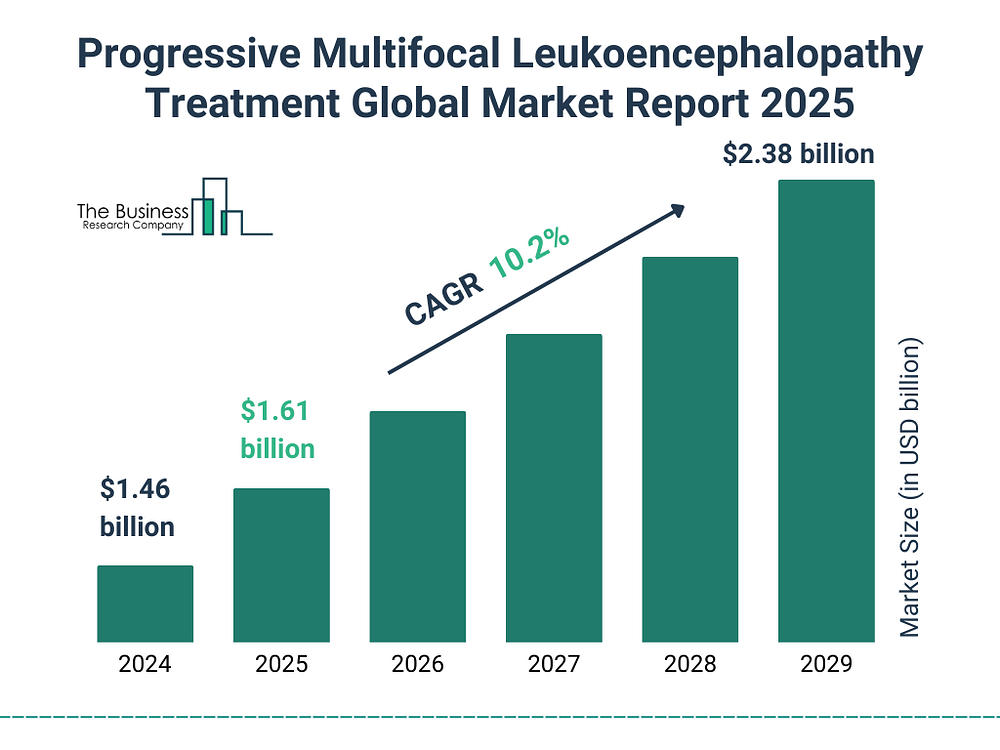
How has the progressive multifocal leukoencephalopathy treatment market size changed in recent years, and what is the outlook ahead?
The progressive multifocal leukoencephalopathy treatment market size has grown rapidly in recent years. It will grow from $1.46 billion in 2024 to $1.61 billion in 2025 at a compound annual growth rate (CAGR) of 10.6%. The growth in the historic period can be attributed to prevalence of underlying conditions, rise in immunosuppressed patients, patient advocacy and awareness, rise of HIV/aids epidemic.
The progressive multifocal leukoencephalopathy treatment market size is expected to see rapid growth in the next few years. It will grow to $2.38 billion in 2029 at a compound annual growth rate (CAGR) of 10.2%. The growth in the forecast period can be attributed to increasing digital health and telemedicine, growing adoption of targeted therapy, improved diagnostic tools, growing awareness of progressive multifocal leukoencephalopathy (PML). Major trends in the forecast period include technological advancements in progressive multifocal leukoencephalopathy (PML) treatment, research and clinical trials, early diagnosis and screening, development of new drug therapies.
Download Your Free Sample PDF:
https://www.thebusinessresearchcompany.com/sample.aspx?id=12864&type=smp
What are the top economic and technological drivers pushing progressive multifocal leukoencephalopathy treatment market growth?
The growing prevalence of human immunodeficiency virus (HIV) infection is expected to propel the growth of the progressive multifocal leukoencephalopathy market going forward. HIV is a retrovirus that attacks the immune system, specifically targeting CD4 cells (also known as T cells), which play a crucial role in helping the body fight infections. Most patients with HIV infection develop PML due to a poor immunological condition indicated by a low CD4 cell count (200/L), the single most significant cause of PML cases worldwide. When a severe HIV-related immune deficit arises, the latent JCV archetype strain in the brain may increase, leading to brain white matter lesions and PML. For instance, in December 2022, according to the Joint United Nations Programme on HIV and AIDS (UNAIDS), a Switzerland-based joint venture of the United Nations for AIDS, 630,000 (480,000–880,000) people died from AIDS-related illnesses and there were 39.0 million [33.1 million–45.7 million] people living with HIV globally. In 2022, 1.3 million [1 million–1.7 million] additional people developed HIV for the first time. Therefore, the growing prevalence of human immunodeficiency virus (HIV) infection is driving the growth of the progressive multifocal leukoencephalopathy market.
class=reporthtag>Progressive Multifocal Leukoencephalopathy Treatment Market Driver: Increasing Significance Of Research And Development In The Progressive Multifocal Leukoencephalopathy Treatment Market
The rising research and development activities are expected to propel the growth of the progressive multifocal leukoencephalopathy treatment market going forward. Rising research and development (R&D) activities refer to the increasing efforts and investments directed toward scientific investigation, experimentation, and innovation in various fields. Research and development activities are critically important for the treatment and management of progressive multifocal leukoencephalopathy (PML) for the development of improved therapies, earlier diagnosis, and better management of the disease. For instance, in December 2023, according to Eurostat, a Luxembourg-based government agency, in 2022, the EU allocated €352 billion ($380.40 billion) to research and development (R&D), representing a 6.34% rise from the €331 billion ($357.71 billion) invested in 2021. Therefore, rising research and development activities are driving the growth of the progressive multifocal leukoencephalopathy treatment market.
How is the progressive multifocal leukoencephalopathy treatment market segmented by product, application, and end-user?
The progressive multifocal leukoencephalopathy treatment market covered in this report is segmented –
1) By Treatment: Anti-retroviral Therapy, Antiviral Or Anti-John Cunningham Virus (JCV), Other Symptomatic
2) By Indication: HIV Or AIDS, Organ Transplantation, Multiple Sclerosis, Hematologic Malignancies
3) By Route of Administration: Oral, Parenteral, Other Routes Of Administration
4) By End-Users: Hospitals, Homecare, Specialty Centers, Other End-Users
Subsegments:
1) By Anti-retroviral Therapy: NRTIs (Nucleoside Reverse Transcriptase Inhibitors), NNRTIs (Non-Nucleoside Reverse Transcriptase Inhibitors), PIs (Protease Inhibitors), Integrase Inhibitors
2) By Antiviral Or Anti-John Cunningham Virus (JCV): Natalizumab, Fumaric Acid Esters, Other JCV-targeted Therapies
3) By Other Symptomatic Treatments: Corticosteroids, Immunomodulators, Supportive Care, Symptomatic Relief Medications
View The Full Market Report:
https://www.thebusinessresearchcompany.com/report/progressive-multifocal-leukoencephalopathy-treatment-global-market-report
Which major trends are influencing the growth of the progressive multifocal leukoencephalopathy treatment industry?
Major companies operating in the advanced multifocal leukoencephalopathy treatment market are increasingly focusing on product innovation to provide reliable products to their customers and to strengthen their market position. For instance, in October 2022, Cellevolve Bio, a US-based clinical company, received FDA (The United States Food and Drug Administration) clearance for an investigational new drug (IND) application and orphan drug designation for CE-VST01-JC. This drug aims to treat progressive multifocal leukoencephalopathy and will be evaluated in a global, multi-center, randomized, double-blind, placebo-controlled Phase 2 trial called ASCEND-JC. The problem seeks to compare CE-VST01-JC to a placebo to see if CE-VST01-JC can decrease or prevent neurological progression in PML patients. CE-VST01-JC is a T-cell therapy that targets the JC virus, the cause of PML. It is a significant moment for the PML community and Cellevolve, as the most considerable cell treatment study in PML history will be ASCEND-JC.
Which leading companies are dominating the progressive multifocal leukoencephalopathy treatment market landscape?
Major companies operating in the progressive multifocal leukoencephalopathy treatment market are Pfizer Inc., Johnson & Johnson, Roche Holding AG, Merck & Co. Inc., AbbVie Inc., Novartis AG, Bristol Myers Squibb Company, Sanofi S.A., Takeda Pharmaceutical Company Limited, Acorda Therapeutics, Eli Lilly and Company, Gilead Sciences Inc., Amgen Inc., Viatris Inc., Teva Pharmaceutical Industries Ltd., Biogen Inc., Eisai Co. Ltd., Otsuka Pharmaceutical Co. Ltd., Jazz Pharmaceuticals PLC, Ipsen Pharma, Apotex Inc., Alkermes PLC, Alnylam Pharmaceuticals Inc., Genentech Inc., Karyopharm Therapeutics Inc., ARIAD Pharmaceuticals Inc., Spectrum Pharmaceuticals, Neurimmune AG, NeoImmuneTech, Inhibikase Therapeutics Inc.
Which geographic areas are expected to offer the highest growth opportunities in theprogressive multifocal leukoencephalopathy treatment market?
North America was the largest region in the progressive multifocal leukoencephalopathy treatment market in 2024. The regions covered in the progressive multifocal leukoencephalopathy treatment market report are Asia-Pacific, Western Europe, Eastern Europe, North America, South America, Middle East and Africa.
How Can Companies Use The Progressive Multifocal Leukoencephalopathy Treatment Market Report to Drive Business Results?
This report provides actionable insights tailored for business use — not academic analysis. Companies can leverage the data to:
• Time market entry or expansion using growth forecasts and CAGR trends.
• Develop competitive products by tracking key technology shifts and user preferences.
• Tailor regional strategies with in-depth geographic data and local market dynamics.
• Benchmark and plan partnerships using competitive landscape insights.
Purchase The Report And Get A Swift Delivery:
https://www.thebusinessresearchcompany.com/purchaseoptions.aspx?id=12864
Need Customized Data On Progressive Multifocal Leukoencephalopathy Treatment Market?
For companies needing more tailored intelligence, The Business Research Company offers customized consulting and data services. Whether you’re entering new regions, launching innovative products, or assessing M&A opportunities, our experts can develop actionable insights specific to your business objectives.
Request Customized Data:
https://www.thebusinessresearchcompany.com/customise?id=12864&type=smp
About The Business Research Company:
With over 15000+ reports from 27 industries covering 60+ geographies, The Business Research Company has built a reputation for offering comprehensive, data-rich research and insights. Armed with 1,500,000 datasets, the optimistic contribution of in-depth secondary research, and unique insights from industry leaders, you can get the information you need to stay ahead.
Our flagship product, the Global Market Model, is a premier market intelligence platform delivering comprehensive and updated forecasts to support informed decision-making.
Contact Us:
The Business Research Company
https://thebusinessresearchcompany.com/
Americas +1 310–496-7795
Asia +44 2071930708
Europe +44 7882 955267
Email us at info@tbrc.info
Follow Us On:
LinkedIn: https://in.linkedin.com/company/the-business-research-company

Comments
Post a Comment