Paroxysmal Nocturnal Hemoglobinuria (PNH) Treatment Market Size Expansion: Projected to Hit $10.09 Billion by 2029 with 13.5% Growth
The Business Research Company’s report on the Paroxysmal Nocturnal Hemoglobinuria (PNH) Treatment Market provides insights into the global market size, growth rate, regional distribution, competitive landscape, key segments, emerging trends, and strategic opportunities.
What are the primary drivers fueling the growth of the paroxysmal nocturnal hemoglobinuria (pnh) treatment market in recent years?
The increasing incidence of hematologic disorders is expected to propel the growth of the paroxysmal nocturnal hemoglobinuria (PNH) treatment market going forward. Hematologic disorders refer to a broad category of medical conditions affecting the blood and blood-forming organs, including abnormalities in red blood cells, white blood cells, platelets, bone marrow, and the coagulation system, which can lead to anemia, clotting disorders, or malignancies. The increasing incidence of hematologic disorders is driven by factors such as aging populations and genetic predispositions, with genetic mutations playing a critical role as they can trigger abnormal blood cell production, leading to various hematologic conditions. Paroxysmal nocturnal hemoglobinuria (PNH) treatment positively manages hematologic disorders by offering targeted therapies that mitigate complement-mediated hemolysis, reduce thrombotic complications, and improve patient survival outcomes. For instance, in July 2024, according to Cancer Research UK, a UK-based charity organization, the average number of new leukemia (a hematologic disorder) cases in the UK is expected to increase from approximately 12,400 in 2023–2025 to around 14,500 by 2038–2040. Therefore, the increasing prevalence of hematologic disorders drives the growth of the paroxysmal nocturnal hemoglobinuria (PNH) treatment market.
Access Your Free Sample of the Global Paroxysmal Nocturnal Hemoglobinuria (PNH) Treatment Market Report — Get Insights Now!
https://www.thebusinessresearchcompany.com/sample.aspx?id=23469&type=smp
What is the projected market size of the paroxysmal nocturnal hemoglobinuria (pnh) treatment industry, and how is it expected to grow?
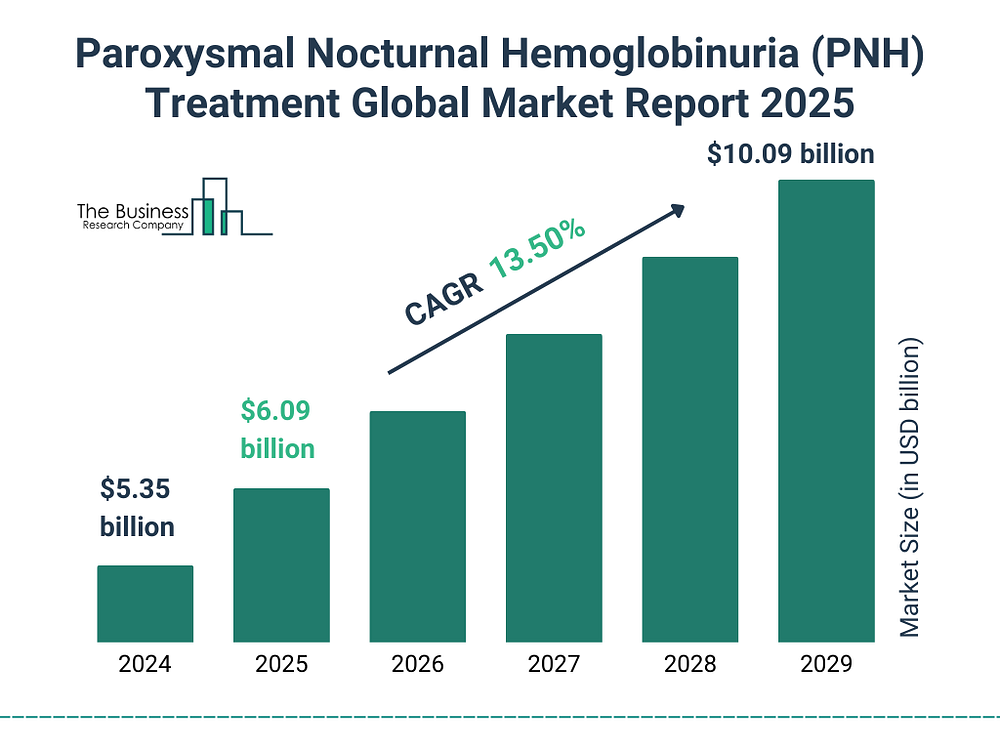
The paroxysmal nocturnal hemoglobinuria (PNH) treatment market size has grown rapidly in recent years. It will grow from $5.35 billion in 2024 to $6.09 billion in 2025 at a compound annual growth rate (CAGR) of 13.8%. The growth in the historic period can be attributed to the high prevalence of neurological disorders and chronic pain conditions, growing awareness of the condition, increasing prevalence of paroxysmal nocturnal hemoglobinuria (PNH), increasing awareness about rare hematological disorders, and increasing regulatory approvals and research and development (R&D).
The paroxysmal nocturnal hemoglobinuria (PNH) treatment market size is expected to see rapid growth in the next few years. It will grow to $10.09 billion in 2029 at a compound annual growth rate (CAGR) of 13.5%. The growth in the forecast period can be attributed to the growing prevalence of rare diseases, increasing healthcare expenditure and access to advanced therapies, increasing investment in healthcare infrastructure, a rise in home-based testing and remote monitoring, and increasing research and development activities. Major trends in the forecast period include advancements in genetic testing and biomarkers, advances in therapies, development of targeted therapies, advancements in biotechnology, and development of novel therapies.
Gain Exclusive Market Insights — Customize Your Research Report Today For Fast Delivery!
https://www.thebusinessresearchcompany.com/customise?id=23469&type=smp
Who are the key players driving competition in the paroxysmal nocturnal hemoglobinuria (pnh) treatment market?
Major companies operating in the paroxysmal nocturnal hemoglobinuria (PNH) treatment market are F. Hoffmann-La Roche Ltd, AstraZeneca PLC, Novartis AG, Amgen Inc., Mayo Clinic, Regeneron Pharmaceuticals, Cleveland Clinic Foundation, Johns Hopkins Medicine, Memorial Sloan Kettering Cancer Center, Stanford Health Care, University of California San Francisco (UCSF) Health, Emory Healthcare, Cedars-Sinai Medical Center, Duke University Health System, Mount Sinai Health System, Dana-Farber Cancer Institute, Swedish Orphan Biovitrum, Alnylam Pharmaceuticals, BioCryst Pharmaceuticals, Apellis Pharmaceuticals
What key trends are expected to drive the oxygen conserving devices market during the forecast period?
Major companies operating in the paroxysmal nocturnal hemoglobinuria (PNH) treatment market are focusing on developing innovative solutions, such as oral factor B inhibitors, to introduce a novel treatment option that enhances therapeutic effectiveness and improves patient convenience in managing PNH. An oral Factor B inhibitor is a targeted small-molecule drug that selectively inhibits Factor B in the alternative complement pathway, aiming to regulate immune system overactivation and reduce inflammation in complement-mediated diseases. For instance, in December 2023, Novartis AG, a Switzerland-based pharmaceutical corporation, announced the food and drug administration (FDA) approval of Fabhalta (iptacopan) as the first oral monotherapy for the treatment of paroxysmal nocturnal hemoglobinuria (PNH). This novel Factor B inhibitor provides a more comprehensive approach to controlling complement-mediated hemolysis by targeting the alternative complement pathway at an earlier stage, resulting in improved hemoglobin levels and a reduced need for blood transfusions. The approval of Fabhalta marks a groundbreaking advancement in PNH treatment by offering enhanced efficacy, better patient compliance, and an alternative to intravenous therapies, thereby transforming the treatment landscape for this rare hematologic disorder.
Which key geographies are driving the growth of the paroxysmal nocturnal hemoglobinuria (pnh) treatment market?
North America was the largest region in the paroxysmal nocturnal hemoglobinuria (PNH) treatment market in 2024. Asia-Pacific is expected to be the fastest-growing region in the forecast period. The regions covered in the paroxysmal nocturnal hemoglobinuria (PNH) treatment market report are Asia-Pacific, Western Europe, Eastern Europe, North America, South America, Middle East, Africa.
Order Your Report Now For Swift Delivery
https://www.thebusinessresearchcompany.com/report/paroxysmal-nocturnal-hemoglobinuria-pnh-treatment-global-market-report
What are the key segments driving growth in the paroxysmal nocturnal hemoglobinuria (pnh) treatment market?
The paroxysmal nocturnal hemoglobinuria (PNH) treatment market covered in this report is segmented –
1) By Treatment Type: Complement C5 Inhibitors, Anti-Complement Component 5a Receptor (C5aR) Monoclonal Antibodies, Alternative Pathway Inhibitors, Hematopoietic Stem Cell Transplantation, Other Therapies
2) By Route Of Administration: Intravenous, Subcutaneous, Oral
3) By market Availability: Approved, In Pipeline, Investigational
4) By End-Use: Hospitals, Specialty Clinics, Homecare Settings, Other End-Users
Subsegments:
1) By Complement : C5 InhibitorsEculizumab (Soliris), Ravulizumab (Ultomiris), Emerging C5 Inhibitors, Biosimilars Of C5 Inhibitors,
2) By Anti-Complement Component 5a Receptor Monoclonal Antibodies: Avacopan (Tavneos), Other Investigational C5aR mAbs, Monotherapy vs Combination Therapy, Clinical Trial Phase (Phase I, II, III)
3) By Alternative Pathway Inhibitors: C3 Inhibitors, Factor B Inhibitors, Factor D Inhibitors, Targeting Complement Amplification, Combination Therapies And Dual Inhibition
4) By Hematopoietic Stem Cell Transplantation (HSCT) : Autologous HSCT vs. Allogeneic HSCT, Pre-Transplant Conditioning Therapies, Post-Transplant Immunosuppressive Therapies
5) By Other Therapies: Immunosuppressive Therapy, Supportive Care, Anticoagulation Therapy, Gene Therapy
Purchase The Exclusive Report Now To Unlock Valuable Market Insights:
https://www.thebusinessresearchcompany.com/purchaseoptions.aspx?id=23469
How is the paroxysmal nocturnal hemoglobinuria (pnh) treatment market defined, and what are its core characteristics?
Paroxysmal nocturnal hemoglobinuria (PNH) treatment refers to medical therapies to manage PNH, a rare blood disorder characterized by hemolysis (destruction of red blood cells), blood clots, and bone marrow dysfunction. Paroxysmal nocturnal hemoglobinuria (PNH) is a rare, acquired hematologic disorder characterized by the destruction of red blood cells due to complement-mediated hemolysis, bone marrow dysfunction leading to cytopenias, and an increased risk of thrombosis. Paroxysmal nocturnal hemoglobinuria (PNH) management focuses on inhibiting complement activation to prevent hemolysis, addressing bone marrow failure, and mitigating thrombotic complications to improve patient outcomes and quality of life.
About The Business Research Company:
With over 15000+ reports from 27 industries covering 60+ geographies, The Business Research Company has built a reputation for offering comprehensive, data-rich research and insights. Armed with 1,500,000 datasets, the optimistic contribution of in-depth secondary research, and unique insights from industry leaders, you can get the information you need to stay ahead.
Our flagship product, the Global Market Model, is a premier market intelligence platform delivering comprehensive and updated forecasts to support informed decision-making.
Contact Us:
The Business Research Company
https://thebusinessresearchcompany.com/
Europe: +44 207 1930 708
Asia: +91 88972 63534
Americas: +1 315 623 0293
Email: info@tbrc.info
Follow Us On:
LinkedIn: https://in.linkedin.com/company/the-business-research-company

Comments
Post a Comment