What’s Fueling Industrial Fabric Market Growth? Key Trends and Market Size Forecasts
The Business Research Company’s report on the Industrial Fabric Market provides insights into the global market size, growth rate, regional distribution, competitive landscape, key segments, emerging trends, and strategic opportunities.
How have key drivers contributed to the rapid growth of the industrial fabric market?
Increasing demand for vehicle production is expected to propel the growth of the industrial fabric market going forward. Vehicle production is creating motorized vehicles, such as cars, trucks, motorcycles, and other types of vehicles. Industrial fabrics like polyester and nylon are used in vehicle production, and polyester fiber may be found in a variety of applications in the automobile sector, including knitted, woven, and nonwoven textiles, particularly needle punch and stitch bond fabrics used as face materials, and woven fabrics in airbags and seat belts. For instance, in June 2023, according to the European Automobile Manufacturers Association, a Belgium-based industry association representing the interests of automobile manufacturers in Europe, approximately 13 million Europeans are employed in the automotive industry, representing 7% of all EU jobs. The sector accounts for 11.5% of EU manufacturing jobs, totaling about 3.4 million positions. The EU produces 13.1 million cars, vans, trucks, and buses annually, making it a strategic industry. The European auto sector is a global leader, generating a €101.9 billion trade surplus with its high-quality Made in Europe products. Therefore, an increasing demand for vehicle production is driving the growth of the industrial fabric market.
Access Your Free Sample of the Global Industrial Fabric Market Report — Get Insights Now!
https://www.thebusinessresearchcompany.com/sample.aspx?id=11895&type=smp
How has the industrial fabric market size evolved, and what are the latest forecasts for its expansion?
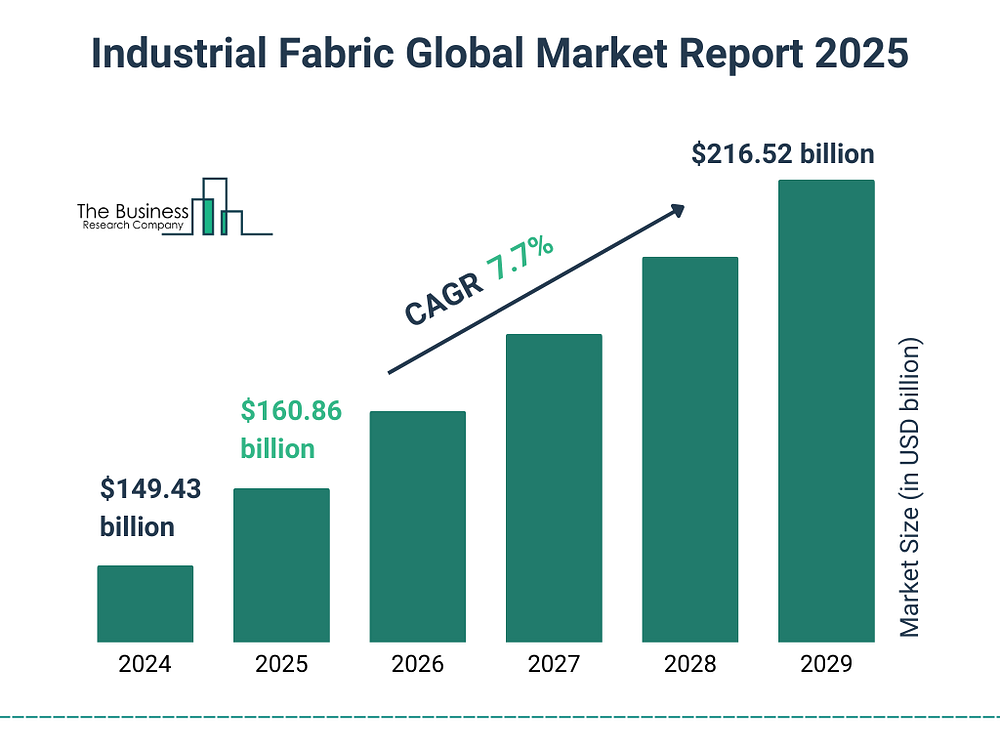
The industrial fabric market size has grown strongly in recent years. It will grow from $149.43 billion in 2024 to $160.86 billion in 2025 at a compound annual growth rate (CAGR) of 7.6%. The growth in the historic period can be attributed to growth in manufacturing and industrial sectors, expansion of construction activities, automotive industry requirements, agricultural applications, environmental concerns and regulations
The industrial fabric market size is expected to see strong growth in the next few years. It will grow to $216.52 billion in 2029 at a compound annual growth rate (CAGR) of 7.7%. The growth in the forecast period can be attributed to rise in infrastructure projects, expanding e-commerce and logistics, advancements in agriculture techniques, increased emphasis on sustainable solutions, innovation in protective clothing. Major trends in the forecast period include customization and specialization in fabric solutions, growth in demand for high-temperature resistant fabrics, utilization of industrial fabrics in architecture, expansion of industrial fabric applications in healthcare, integration of digitalization in fabric manufacturing.
Gain Exclusive Market Insights — Customize Your Research Report Today For Fast Delivery!
https://www.thebusinessresearchcompany.com/customise?id=11895&type=smp
Which major companies dominate the industrial fabric market?
Major companies operating in the industrial fabric market include Saint-Gobain S.A., Bridgestone Corporation, Kimberly-Clark Corporation, Toray Industries Inc., Berry Global Inc., DuPont de Nemours Inc., Ahlstrom-Munksjö Oyj, Donaldson Company Inc., Milliken & Company, Lenzing AG, Freudenberg Performance Materials SE & Co KG, Low & Bonar PLC, Forbo International SA, Albany International Corp., Cone Mills Corporation, Johns Manville Corp, Hollingsworth & Vose Co, Fitesa SA, Scott Bader Co Ltd., GSE Environmental, Habasit AG, Leigh Fibers, Tabb Textile Company Inc., Apex Mills Corp, MBK Tape Solutions, Eastex Products LLC, Dunham Rubber & Belting Corp, Herculite Products Inc., Jason Mills LLC, Cerex Advanced Fabrics Inc., Barnet Gmbh & Co Kg, GR Henderson Co Textiles Ltd., TVF Carmel
What trends will shape the future of the industrial cooling systems market?
Product innovations are the key trend gaining popularity in the industrial fabric market. Major companies operating in the industrial fabric market are adopting new technologies to sustain their position in the market. For instance, in May 2023, TenCate Protective Fabrics, a US-based manufacturer of protective fabrics, launched Tecasafe 360+, an inherently flame-resistant stretch fabric. The Tecasafe 360+ combines the protection of flame-resistant (FR) materials with the comfort and wearability of intrinsic stretch technology. Tecasafe 360+ satisfies all the requirements for contemporary FR-textile-wearing professionals by fusing a specific blend of intrinsic FR materials with the ground-breaking stretch properties of XLANCE fibers. Industrial textiles manufactured with the new technology will be cool to touch, anti-bacterial, anti-viral, mosquito repellent, anti-odor, and antistatic, among other features.
Which region dominates the industrial fabric market, and what factors contribute to its leadership?
Asia-Pacific was the largest region in the industrial fabric market in 2024, and is expected to be the fastest-growing region in the forecast period. The regions covered in the industrial fabric market report are Asia-Pacific, Western Europe, Eastern Europe, North America, South America, Middle East, Africa.
Order Your Report Now For Swift Delivery
https://www.thebusinessresearchcompany.com/report/industrial-fabric-global-market-report
How is the industrial fabric market segmented, and which segment holds the largest share?
The industrial fabric market covered in this report is segmented –
1) By Fiber Type: Aramid, Polyester, Polyamide, Nylon, Fiberglass, Composite, Kevlar, Graphite, Other Fiber Types
2) By Application: Conveyor Belt, Automotive Carpet, Flame Resistance Apparel, Transmission Belt, Protective Apparel, Other Applications
3) By End-User: Clothing, Homeware, Accessories, Other End-Users
Subsegments:
1) By Aramid: Para-Aramid, Meta-Aramid
2) By Polyester: PET (Polyethylene Terephthalate), PBT (Polybutylene Terephthalate)
3) By Polyamide: Nylon 6, Nylon 66
4) By Nylon: Nylon 6,6, Nylon 6
5) By Fiberglass: E-Glass, S-Glass
6) By Composite: Carbon Fiber Composites, Glass Fiber Composites
7) By Kevlar: Kevlar 29, Kevlar 49
8) By Graphite: Carbon Fiber Reinforced Graphite, Graphene-Based Fabrics
9) By Other Fiber Types: Natural Fibers, Specialty Synthetic Fibers
Purchase The Exclusive Report Now To Unlock Valuable Market Insights:
https://www.thebusinessresearchcompany.com/purchaseoptions.aspx?id=11895
How is the industrial fabric market defined?
Industrial fabric refers to materials developed and engineered for use in goods, processes, or services where practical requirements precede the aesthetic form associated with textiles. Industrial fabrics are frequently constructed with qualities that allow them to function in certain situations.
About The Business Research Company:
With over 15000+ reports from 27 industries covering 60+ geographies, The Business Research Company has built a reputation for offering comprehensive, data-rich research and insights. Armed with 1,500,000 datasets, the optimistic contribution of in-depth secondary research, and unique insights from industry leaders, you can get the information you need to stay ahead.
Our flagship product, the Global Market Model, is a premier market intelligence platform delivering comprehensive and updated forecasts to support informed decision-making.
Contact Us:
The Business Research Company
https://thebusinessresearchcompany.com/
Europe: +44 207 1930 708
Asia: +91 88972 63534
Americas: +1 315 623 0293
Email: info@tbrc.info
Follow Us On:
LinkedIn: https://in.linkedin.com/company/the-business-research-company

Comments
Post a Comment