Retinal Biologics Market Surges Amid Rising Cases Of Diabetic Eye Disease Driver Leading Retinal Biologics Market Growth: Key Factors Shaping 2025 Expansion
The Business Research Company’s report on the Retinal Biologics Market provides insights into the global market size, growth rate, regional distribution, competitive landscape, key segments, emerging trends, and strategic opportunities.
What are the key drivers behind the retinal biologics market’s growth in recent years?
The increasing prevalence of diabetic eye disease is expected to propel the growth of the retinal biologics market going forward. Diabetic eye disease is a complication of diabetes that affects the eyes by causing vision loss and blindness in people with diabetes. Retinal biologics hold the potential for more precise and effective treatment options, allowing for earlier intervention and improved outcomes in preventing vision loss associated with diabetic eye disease. For instance, in December 2023, according to the data from the Australian Bureau of Statistics, an Australia-based government agency, in 2022, 5.3% of the Australian population (about 1.3 million people) had diabetes, marking a notable rise from 3.3%. Therefore, the increasing prevalence of diabetic eye disease is driving the growth of the retinal biologics market.
Access Your Free Sample of the Global Retinal Biologics Market Report — Get Insights Now!
https://www.thebusinessresearchcompany.com/sample.aspx?id=11911&type=smp
How does the future projection of the retinal biologics market size compare to its historical growth?
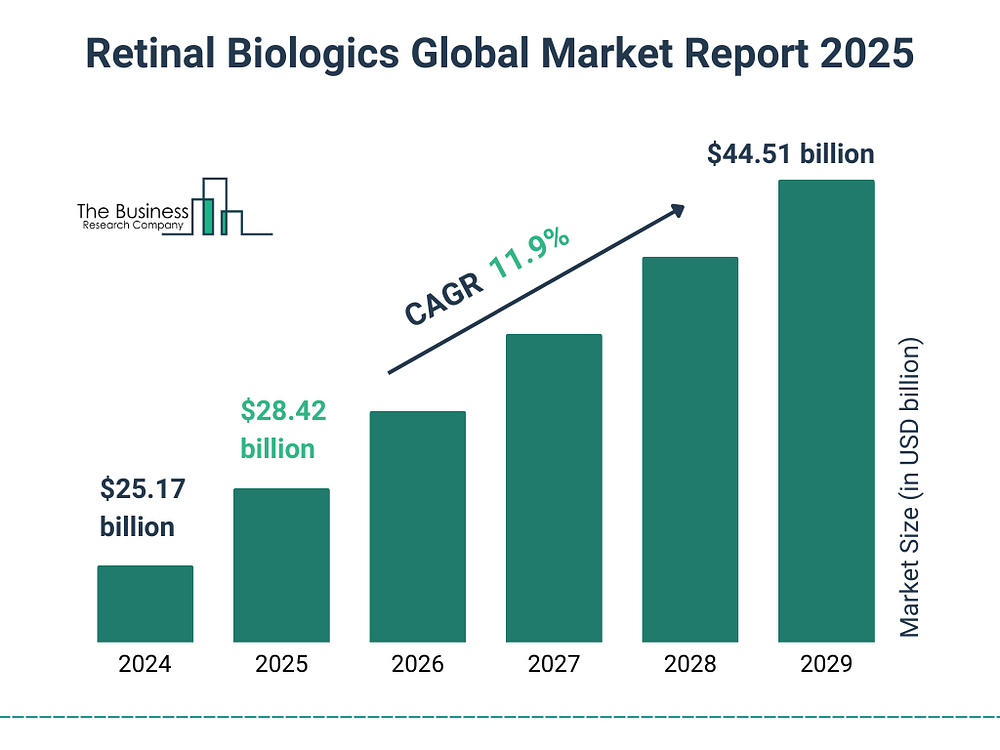
The retinal biologics market size has grown rapidly in recent years. It will grow from $25.17 billion in 2024 to $28.42 billion in 2025 at a compound annual growth rate (CAGR) of 12.9%. The growth in the historic period can be attributed to increased incidence of retinal disorders, aging population, rising awareness and early diagnosis, evolving healthcare infrastructure, and increasing healthcare expenditure
The retinal biologics market size is expected to see rapid growth in the next few years. It will grow to $44.51 billion in 2029 at a compound annual growth rate (CAGR) of 11.9%. The growth in the forecast period can be attributed to expanding therapeutic applications, personalized medicine, emerging market growth, a strong pipeline of biologics, collaborations and partnerships, government initiatives and support. Major trends in the forecast period include non-invasive delivery methods, real-world evidence utilization, expanded indications, regulatory pathway streamlining, and patient-centric outcomes.
Gain Exclusive Market Insights — Customize Your Research Report Today For Fast Delivery!
https://www.thebusinessresearchcompany.com/customise?id=11911&type=smp
Which key players are shaping the future of the retinal biologics market?
Major companies operating in the retinal biologics market include Regeneron Pharmaceuticals Inc., AbbVie Inc., MeiraGTx Limited, Oxurion NV, Novartis AG, Amgen Inc., Spark Therapeutics Inc., Bayer AG, Bausch Health Companies Inc., Merck & Co. Inc., Santen Pharmaceutical Co. Ltd., Pfizer Inc., Boehringer Ingelheim, Eyenovia Inc., EyePoint Pharmaceuticals Inc., Iveric Bio Inc., Kodiak Sciences Inc., Aerie Pharmaceuticals Inc., Alimera Sciences Inc., Ocular Therapeutix Inc., Acucela Inc., Clearside Biomedical Inc., Ophthotech Corporation, Xcovery Holdings, Athenex Inc., Fidia Farmaceutici S.p.A, Eton Pharmaceuticals Inc.
What trends will propel the growth and evolution of the retinal biologics market?
Product innovation is a key trend gaining popularity in the retinal biologics market. Major companies operating in the retinal biologics market are focused on developing innovative products to strengthen their position and gain a competitive advantage. For instance, in May 2023, F. Hoffmann-La Roche Ltd., a Switzerland-based healthcare company, announced that the U.S. Food and Drug Administration had accepted the company’s supplemental biologics license application (sBLA) for Vabysmo (faricimab) for the treatment of macular edema following retinal vein occlusion (RVO). Acceptance was based on two Phase III trials that showed early and persistent visual improvement with Vabysmo, achieving the primary endpoint of non-inferiority to aflibercept. This product is the first bispecific antibody approved for the eye to treat neovascular or ‘wet’ age-related macular degeneration and diabetic macular edema. Further studies showed an absence of blood vessel leakage in the retina in Vabysmo patients compared to aflibercept patients.
Which regions are expected to become dominant players in the retinal biologics market?
North America was the largest region in the retinal biologics market in 2024. Asia-Pacific is expected to be the fastest-growing region in the forecast period. The regions covered in the retinal biologics market report are Asia-Pacific, Western Europe, Eastern Europe, North America, South America, Middle East, Africa.
Order Your Report Now For Swift Delivery
https://www.thebusinessresearchcompany.com/report/retinal-biologics-global-market-report
What are the emerging key segments in the retinal biologics market, and how are they evolving?
The retinal biologics market covered in this report is segmented –
1) By Drug Class: Vascular Endothelial Growth Factor (VEGF)-A Antagonist, Tumor Necrosis Factor (TNF)-A Inhibitor
2) By Indication: Macular Degeneration, Diabetic Retinopathy, Uveitis, Diabetic Macular Edema, Other Indications
3) By Distribution Channel: Hospitals, Pharmacies, Specialty Clinics, Online Pharmacies, Other Distribution Channels
Subsegments:
1) By Vascular Endothelial Growth Factor (VEGF)-A Antagonist: Monoclonal Antibodies, Small Molecule Inhibitors
2) By Tumor Necrosis Factor (TNF)-A Inhibitor: Monoclonal Antibodies, Fusion Proteins
Purchase The Exclusive Report Now To Unlock Valuable Market Insights:
https://www.thebusinessresearchcompany.com/purchaseoptions.aspx?id=11911
What defines the structure and scope of the retinal biologics market?
Retinal biologics refers to bioengineered macromolecules that are implanted inside the eyes to heal chronic retinal diseases. They are highly precise inflammatory mediator-targeting compounds used to treat inflammatory, corneal, and retinal medical conditions.
About The Business Research Company:
With over 15000+ reports from 27 industries covering 60+ geographies, The Business Research Company has built a reputation for offering comprehensive, data-rich research and insights. Armed with 1,500,000 datasets, the optimistic contribution of in-depth secondary research, and unique insights from industry leaders, you can get the information you need to stay ahead.
Our flagship product, the Global Market Model, is a premier market intelligence platform delivering comprehensive and updated forecasts to support informed decision-making.
Contact Us:
The Business Research Company
https://thebusinessresearchcompany.com/
Europe: +44 207 1930 708
Asia: +91 88972 63534
Americas: +1 315 623 0293
Email: info@tbrc.info
Follow Us On:
LinkedIn: https://in.linkedin.com/company/the-business-research-company

Comments
Post a Comment