Emerging Template Market Growth Trends: How Potato Starch is Reshaping Market Size & Industry Expansion
The Business Research Company’s report on the Potato Starch Market provides insights into the global market size, growth rate, regional distribution, competitive landscape, key segments, emerging trends, and strategic opportunities.
How have key drivers contributed to the rapid growth of the potato starch market?
Rising demand for ready-to-eat food products is expected to propel the growth of the potato starch market. Ready-to-eat foods are shelf-stable and don’t need to be refrigerated to stay bacteria-free, which makes them easy to store and use whenever needed. The increased consumer willingness to spend on ready-to-eat food such as fast food, along with a lack of time to prepare at home as a result of rapid urbanization, is the primary factor boosting demand for ready-to-eat meals. Potato starch is generally employed in canned soups and blends where its thickening power, particularly for fill viscosity, is utilized. It is also used as a foundation for gelling agents in confections, thickeners in items such as pastry and pie fillings, and instant puddings. For instance, in October 2023, according to the United States Department of Agriculture, the US-based federal executive department, from 2022 to 2023, the fast-food sector in Japan is anticipated to maintain its growth momentum, with projected sales rising from approximately $26.6 billion in 2022 to around $28.1 billion in 2023, representing a growth rate of approximately 5.6%. Therefore, rising demand for ready-to-eat food products will drive the growth of the potato starch market.
Access Your Free Sample of the Global Potato Starch Market Report — Get Insights Now!
https://www.thebusinessresearchcompany.com/sample.aspx?id=6412&type=smp
How has the potato starch market size evolved, and what are the latest forecasts for its expansion?
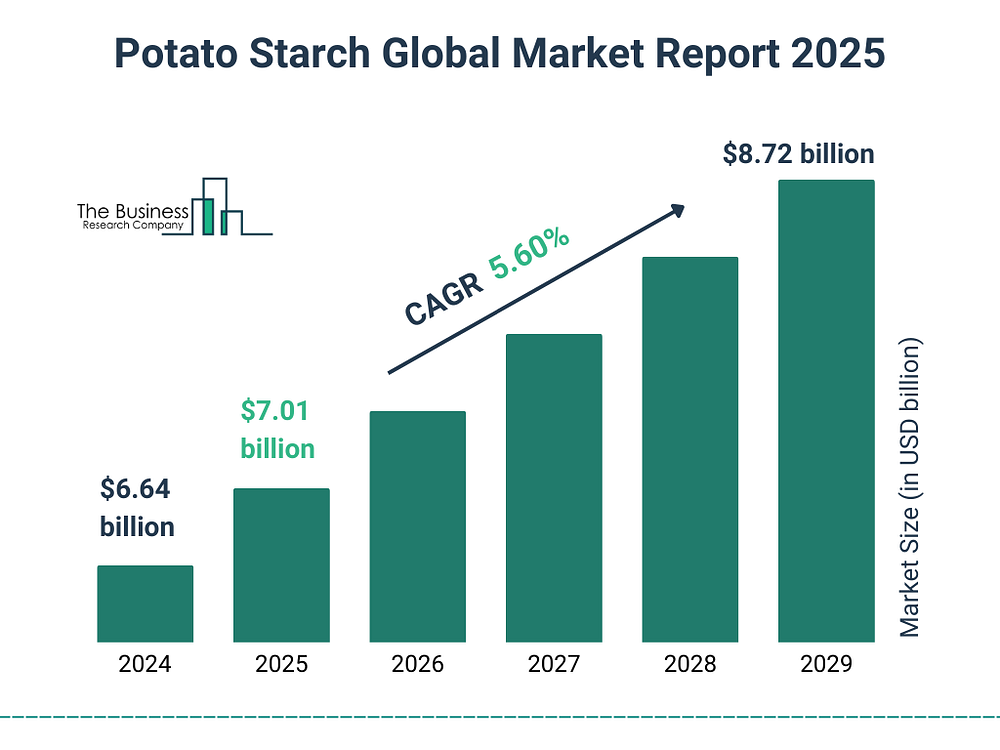
The potato starch market size has grown strongly in recent years. It will grow from $6.64 billion in 2024 to $7.01 billion in 2025 at a compound annual growth rate (CAGR) of 5.6%. The growth in the historic period can be attributed to rise in demand for processed food items, growing demand for gluten-free food products, increased production and export prospects, diversification of potato starch utility across various industries, emergence of modified potato starch to enhance its quality for better performance in various industrial applications.
The potato starch market size is expected to see strong growth in the next few years. It will grow to $8.72 billion in 2029 at a compound annual growth rate (CAGR) of 5.6%. The growth in the forecast period can be attributed to growing demand for completely plant-based food products, rising adoption of veganism globally, increasing awareness aboutThe health benefits of plant-based products, growing industrial applications, rising in gluten-free and allergen-free diets, increasing global food trade and globalization. Major trends in the forecast period include innovative non-food applications, biodegradable packaging, modified starch varieties, clean label and natural ingredients, clean label formulations.
Gain Exclusive Market Insights — Customize Your Research Report Today For Fast Delivery!
https://www.thebusinessresearchcompany.com/customise?id=6412&type=smp
Which major companies dominate the potato starch market?
Major companies operating in the potato starch market include Cargill Incorporated, Pepees SA, Emsland Group, Sudstarke GmbH, Novidon Ltd., Ingredion Inc., AGRANA Beteiligungs-AG, Cooperative AVEBE UA, AKV Langholt AmbA, Tereos Starch & Sweeteners SAS, Roquette Freres SA, Finnamyl Ltd., Manitoba Starch Inc., Tate & Lyle plc, Aloja Starkelsen SIA, KMC Ingredients, Lyckeby Starch AB, Vimal Group, Universal Starch Chem Allied Ltd., Qingdao CBH Co. Ltd., Gujarat Ambuja Exports Ltd., ShreeGluco Biotech Private Ltd., Shubham Starch Chem Pvt. Ltd., Matsutani Chemical Industry Co. Ltd., Sanstar Bio-Polymers Ltd., Jay Sardar Starch & Gum Consultant, Tirupati Starch & Chemicals Ltd., Ambuja Exports Ltd., Daymer Ingredients Limited, The Wah Starch Public Company Limited
What trends will shape the future of the potato processing market?
The introduction of innovative products is a key trend gaining popularity in the potato starch market. Companies in the potato starch market are rapidly investing in developing new products to provide enhanced solutions to their consumers with better qualities. For instance, in 2024, KMC Kartoffelmelcentralen Amba, a Denmark-based ingredient provider, introduced its flagship ingredient, Gelamyl 625, offering a competitive edge through exceptional elasticity. With a low drying temperature of 25°C/77°F — significantly lower than the 55°C/131°F typical of plant-based gelling agents — it enhances processing efficiency. The high elasticity provides a firmer texture, allowing confectionery manufacturers to reduce or fully replace animal-derived gelatin. Additionally, the reduced drying temperature boosts energy and cost efficiency without compromising product quality.
Which region dominates the potato starch market, and what factors contribute to its leadership?
Western Europe was the largest region in the potato starch market in 2024. The regions covered in the potato starch market report include Asia-Pacific, Western Europe, Eastern Europe, North America, South America, Middle East and Africa.
Order Your Report Now For Swift Delivery
https://www.thebusinessresearchcompany.com/report/potato-starch-global-market-report
How is the potato starch market segmented, and which segment holds the largest share?
The potato starch market covered in this report is segmented –
1) By Type: Native Starch, Modified Starch, Sweeteners
2) By Nature: Organic, Conventional
3) By Distribution Channel: Indirect, Direct, Other Distribution Channels
4) By Application: F??d ?ndu?tr?, ????r ?ndu?tr?, ?h?m???l ?ndu?tr?, ???t?l? ?ndu?tr?, Other ?ndu?tries
Subsegments:
1) By Native Starch: Granular Native Potato Starch, Powdered Native Potato Starch, Liquid Native Potato Starch
2) By Modified Starch: Physically Modified Starch, Chemically Modified Starch, Enzymatically Modified Starch
3) By Sweeteners: Maltodextrin, Dextrose, Fructose Syrups
Purchase The Exclusive Report Now To Unlock Valuable Market Insights:
https://www.thebusinessresearchcompany.com/purchaseoptions.aspx?id=6412
How is the potato starch market defined?
Potato starch refers to a fine, white powder derived from the starch found in potatoes. It is extracted from the tubers by crushing them to release the starch grains, which are then dried to produce the starch. Commonly used in cooking and baking, potato starch is known for its thickening properties and is often used as a gluten-free alternative in recipes. It has a neutral flavor, making it suitable for a variety of dishes, such as sauces, soups, gravies, and baked goods.
About The Business Research Company:
With over 15000+ reports from 27 industries covering 60+ geographies, The Business Research Company has built a reputation for offering comprehensive, data-rich research and insights. Armed with 1,500,000 datasets, the optimistic contribution of in-depth secondary research, and unique insights from industry leaders, you can get the information you need to stay ahead.
Our flagship product, the Global Market Model, is a premier market intelligence platform delivering comprehensive and updated forecasts to support informed decision-making.
Contact Us:
The Business Research Company
https://thebusinessresearchcompany.com/
Europe: +44 207 1930 708
Asia: +91 88972 63534
Americas: +1 315 623 0293
Email: info@tbrc.info
Follow Us On:
LinkedIn: https://in.linkedin.com/company/the-business-research-company

Comments
Post a Comment